

Vanilla Malt Layer Cake with Cashews and Salted Caramel
As an amazon associate I earn from qualifying purchases.
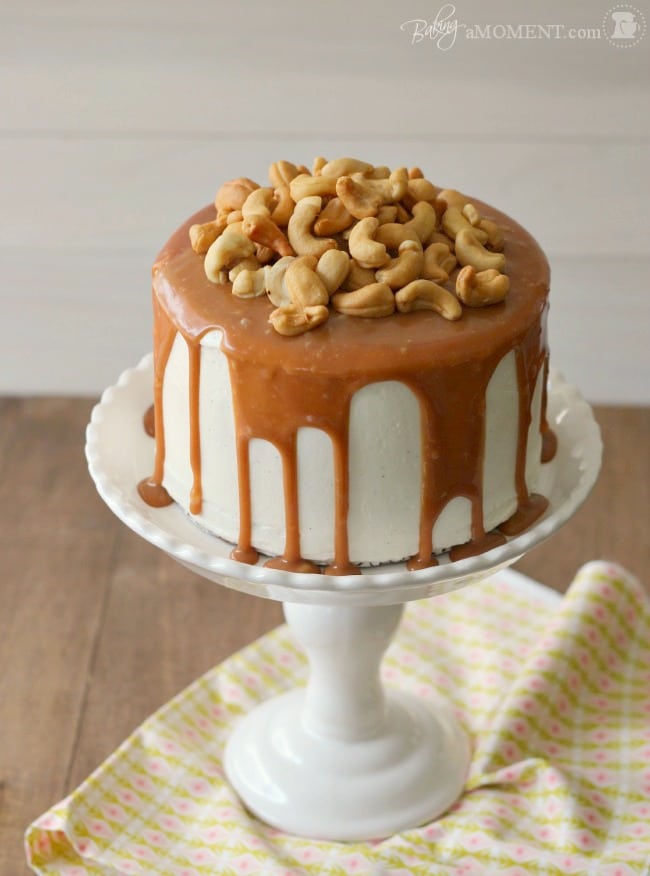
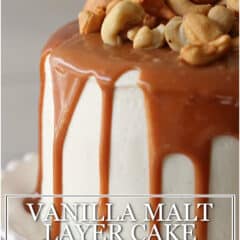
My Vanilla Malt Layer Cake with Cashews and Salted Caramel has a rich vanilla malt flavor, is filled and frosted with Swiss meringue buttercream, and is finished with a drizzle of homemade salted caramel sauce. Roasted cashews add the perfect crunchy topping and look incredible!
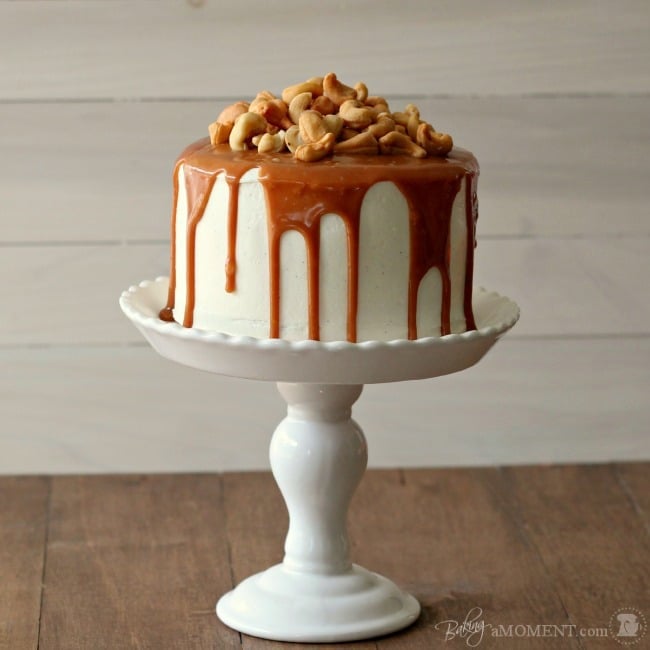
I first made this cake for my mom's birthday. I wanted to make it extra special, and since then, it's become one of my favorite flavor combinations.
The malted milk powder in the batter gives it that classic milkshake taste, and using some Greek yogurt instead of all milk makes the crumb a bit thicker and adds a little tang. Layer it with vanilla Swiss meringue buttercream and finish it with salted caramel and roasted cashews, and you'll have a cake people don't forget.
I used my favorite vanilla cupcake recipe, but with Greek yogurt in place of the milk because I like a thicker batter, and the tang from the yogurt was a nice contrast to all the sweet, and a few tablespoons of malted milk powder. A half recipe filled a 6-inch diameter x 3-inch high round cake pan perfectly.
It poofs way up in the oven, but then it sinks back down a little as it cools.
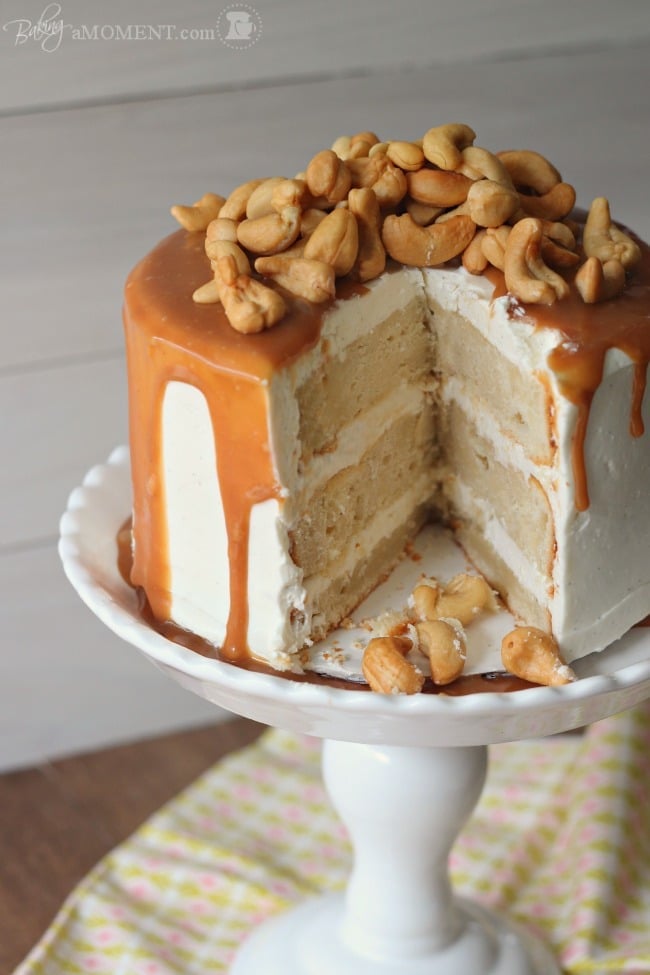
After the cake cools completely and then spends a night in the fridge, split it horizontally into three layers, and fill and frost it with vanilla Swiss meringue buttercream.
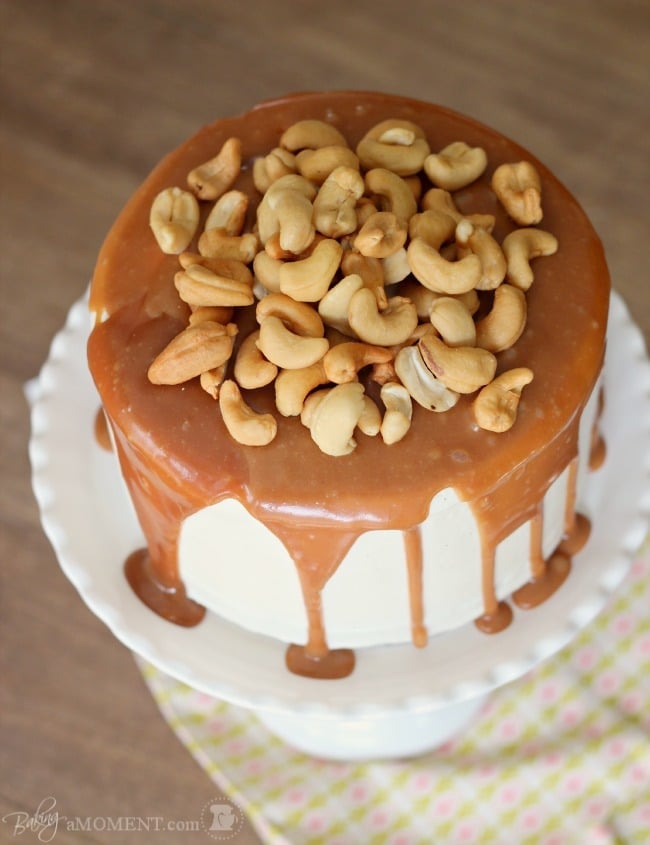
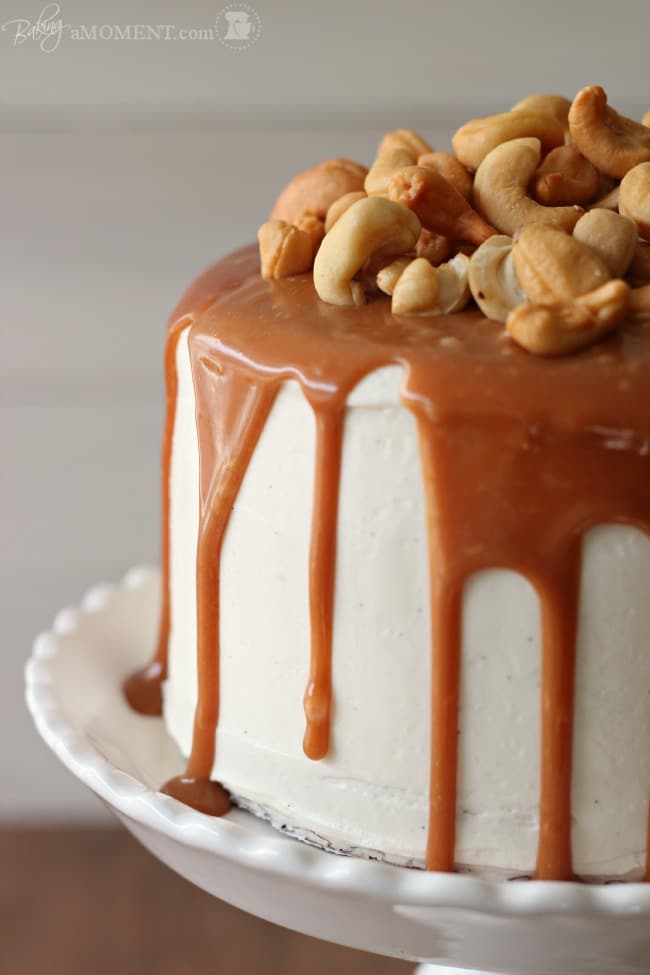
Simply perfect salted caramel sauce gets drizzled all over the top of the cake, and it drips and slips down the sides in the most gratuitous way.
Roasted cashews are Mom's favorite nut (I mean legume ;)), and they are the perfect crowning touch.
You are going to love this flavor combination! The malted milk powder brings out the most incredible richness, and that silky buttercream is just so ethereal! The buttery complexity from the caramel brings it all together, and the cashews give the most satisfying crunch!
Here's Why You'll Love This Recipe
- You'll really notice the malt flavor. Malted milk powder gives every bite that classic milkshake taste.
- The Swiss meringue buttercream is smooth and not overly sweet. It's a little more work than regular American buttercream, but the results are worth it.
- A drizzle of salted caramel is the perfect finishing touch. It adds richness and just the right amount of salt to balance the sweetness.
- Roasted cashews add a great crunch. They might be unexpected, but they're the perfect topping for these flavors.
Ingredients You'll Need
The recipe card at the bottom of the post contains the full list with all of the amounts. Refer to that when you're cooking.
For the Vanilla Malt Cake
- Cake flour and all-purpose flour: Using both makes the cake tender but sturdy enough to hold up through three layers.
- Granulated sugar: Sweetens the batter.
- Malted milk powder: The key to that signature malt flavor.
- Baking powder and baking soda: Work together to give the cake its rise.
- Kosher salt: Balances the sweetness.
- Unsalted butter: Adds richness to the crumb.
- Eggs: Add structure to the batter.
- Milk: Adds moisture to the batter.
- Plain Greek yogurt: Swapping in some yogurt for the liquid makes the batter a bit denser and adds a subtle tang to balance the sweetness.
- Vanilla bean paste: This gives a deep vanilla flavor and those classic vanilla bean specks. If you don't have it, vanilla extract works too.
For the Frosting and Toppings
- Egg whites: The base of the Swiss meringue.
- Granulated sugar: Sweetens the meringue.
- Unsalted butter: Whipped into the meringue to create a silky, stable buttercream.
- Vanilla bean paste: It adds a rich vanilla flavor to the frosting. You can use vanilla extract instead if needed.
- Salted caramel sauce: Drizzled over the finished cake for richness and a salty-sweet finish.
- Whole roasted cashews: These add crunch and really bring all the flavors together.
How To Make Vanilla Malt Layer Cake with Salted Caramel and Roasted Cashews
Step 1: Make Cake
Preheat your oven to 325°F. Spray three 6-inch by 3-inch round cake pans with nonstick spray, then line the bottoms with parchment paper circles.
Mix the dry ingredients. Place the flours, sugar, malted milk powder, baking powder, baking soda, and salt in a medium bowl and whisk to combine.
Add the butter and mix on medium-low speed until the mixture looks like damp sand.
Add the eggs one at a time, making sure each is fully mixed in before adding the next. Scrape down the bowl as needed.
Add the milk, yogurt, and vanilla. Beat on medium-high speed for about a minute to aerate the batter and help it hold together.
Divide the batter evenly between the pans and bake for 20 to 25 minutes. The cakes are done when they spring back if gently pressed and a toothpick comes out clean or with a few moist crumbs.
Let the cakes cool in their pans for 20 minutes, then remove them and let them cool completely on wire racks.
Step 2: Make Frosting
Combine the egg whites and sugar. Place them in a large metal mixing bowl and whisk together.
Heat gently. Set the bowl over a small pot of simmering water and heat, whisking occasionally, until the mixture turns translucent and no longer feels gritty when rubbed between your fingers.
Whip the meringue. Remove from the heat and whip on high speed until glossy and thick.
Let the meringue cool completely. If the bowl still feels warm, chill it in the fridge for 10 to 20 minutes before moving on.
Add the butter a tablespoon at a time, whipping on medium-high speed. After all the butter is mixed in, gently fold in the vanilla.
Step 3: Assemble
To assemble, place one cake layer on a serving plate and spread a layer of buttercream about half an inch thick on top. Add the second layer and repeat.
Add the last cake layer, then frost the top and sides with the rest of the buttercream.
Drizzle caramel sauce about an inch from the edge so it drips down the sides, then sprinkle roasted cashews on top.
Helpful Tips and Tricks
- Be careful when measuring flour. Lightly spoon it into your measuring cup and level it off with a knife instead of scooping from the bag, which can add too much flour.
- Always let the meringue cool completely before adding butter. If it's still warm, the frosting can get thin and runny. If that happens, chill the bowl for 15 to 20 minutes and whip it again.
- Make sure your caramel sauce is at room temperature, not warm, or it will melt the frosting. If it's too thick to drizzle, add water a tiny bit at a time until it's just right.
- Make sure the cakes are fully baked before taking them out of the oven. If they're underbaked, they will sink as they cool. Check them with a toothpick. It should come out clean or with a few moist crumbs.
- Keep the finished cake covered in the fridge for up to four days. For the best texture, let slices sit at room temperature for about 20 minutes before serving.
Vanilla Malt Layer Cake with Cashews and Salted Caramel
Ingredients
For the Vanilla Malt Cake
- 1 ½ cups (187.5 g) cake flour
- ¾ cup (93.75 g) all-purpose flour
- 1 cup (200 g) granulated sugar
- 1 tablespoon malted milk powder
- 1 ½ teaspoons baking powder
- ¾ teaspoon baking soda
- ¾ teaspoon kosher salt, (scant)
- ¾ cup (170.25 g) unsalted butter, (1 ½ sticks), softened
- 3 eggs, (large)
- ⅔ cup (157.73 ml) milk
- ½ cup (100 g) plain Greek yogurt
- 1 ½ teaspoons vanilla bean paste, (extract may be substituted)
For the Frosting and Toppings
- 3 egg whites, (large)
- 1 cup (200 g) granulated sugar
- 1 cup (227 g) unsalted butter, (2 sticks), softened but still cool
- 1 teaspoon vanilla bean paste, (extract may be substituted)
- ⅓ cup (78.86 ml) salted caramel sauce
- ½ cup (68.5 g) whole roasted cashews
Instructions
To Make the Vanilla Malt Cake:
- Preheat the oven to 325 degrees F, and mist three 6-inch diameter x 3-inch deep cake pans with non-stick spray.
- Cut three circles from parchment paper, and place them in the bottoms of each pan.
- Place the flours, sugar, malted milk powder, baking powder, baking soda, and salt in a medium bowl and whisk to combine.
- Add the butter, and mix on medium-low speed, until the mixture resembles damp sand.
- Stir in the eggs, one at a time, until fully incorporated, stopping to scrape the bottom and sides of the bowl with a silicone spatula after each addition.
- Add the milk, yogurt, and vanilla, and beat on medium-high speed for about 1 minute, to aerate the batter and strengthen the cake's structure.
- Transfer the batter to the prepared pans, and bake for 20-25 minutes, or until the cakes spring back when gently pressed and toothpick inserted in the center comes out clean or with a few moist crumbs.
- Cool for twenty minutes, then unmold and place on wire racks to cool completely.
To Make the Frosting and Assemble the Cake:
- Place the egg whites and sugar in a large metal mixing bowl and whisk together.
- Set the bowl over a small pot of simmering water, and heat, whisking occasionally, until the mixture becomes translucent and no longer feels gritty when rubbed between the thumb and forefinger.
- Remove from heat and whip on high speed until the meringue becomes glossy and thick.
- Cool completely (there should be no hint of warmth when the hand is place on the side of the bowl. Place in the refrigerator for 10-20 minutes, if necessary.)
- Add the butter, a tablespoon at a time, while whipping on medium-high. When all the butter has been added, fold in the vanilla.
- Place one of the cooled cake rounds on a serving platter. Top with a layer of vanilla buttercream, smoothing to a thickness of about ½-inch.
- Place another cake layer on top, and repeat.
- Top with the final layer of cake, and frost the top and sides of the cake with the remaining frosting.
- Drizzle the caramel sauce about an inch in from the outside edge of the cake, allowing it to drip down the sides.
- Top with cashews.
Notes
- This recipe has been updated, for ease of use and to yield a better result, as of 10.12.2015.
- Do NOT use warm caramel sauce. It will melt the frosting! If your caramel sauce is too thick, thin it with a little water (an eighth teaspoon at a time), until the proper consistency is reached.

Wait... when does the 1 1/2 sticks of butter go in?? I see it listed in the ingredients, but not in the cake directions. I just pulled them out of the oven too. 🙁
Hey Kate! You'll want to add the butter to the dry ingredients and mix just until it resembles damp sand. Then the eggs can go in, and then the liquid ingredients. It's known as the reverse creaming method and I love it because it allows everything to happen in one bowl, and you don't have to worry as much about over-mixing. Hope that helps!
I was wondering... How do you measure your cake flour? I weigh most of my stuff (especially flour, since it's so annoying to measure properly), and I found that when I weigh the cake flour, then 150g (which is supposed to be 1.5 cups specifically cake flour) come out to like... 1 1/4 cups when I put it in dry measuring cups. That's quite a notable difference! o_O; I used the 150g measurement since it's technically correct, and the cakes are in the oven now, but I'm nervous. So before I make the second batch, I'm going to wait and see how these come out. Have you ever weighed the flour and noticed a difference? Or do you have any experience between dry-cup measuring and weighing with this recipe?
I definitely agree- weighing is much more precise and it's certainly preferred by professionals. When I worked as a pastry chef, everything was weighed. But I've found that most of my readers like to use old-fashioned measuring cups, so that is what I do. I just fluff up the flour a little bit with a spoon, then lightly spoon it into the cup until it's overflowing. Then I use the back of a knife to level. If you google "how to measure ingredients properly," you'll see that this is a pretty standard way of doing it. 😉
Hey! I was wondering if you ever doubled this recipe? Or... does it really work if you use larger pans? Like 8inch? I'd like to make it for about a crowd of 30ish, so... I wanted maybe... four 6 inch layers (other desserts will be around; it's a big Thanksgiving-type gathering) split in two and two, or... I don't know. I don't have 6 6 inch pans. haha. But do you think the batch would work doubled? Or split into 8 or 9 inch pans? I'm nervous! Thanks!
Gosh Kate I'm really not sure? I've only ever done it this way. Sometimes I refer to this chart- maybe you'll find it helpful too. It's worth a try! Good luck and let me know how you make out!
I'm too nervous to risk making it in the larger pan! Haha. I'm just going to do the 6 inch and do it twice for this event... But if you ever decide to ever play with the recipe again, I'm officially placing a formal request for a test with an 8 inch cake pan! 😀
Thanks for the quick reply! ^_^
Will do, Kate! Good luck and I hope you enjoy!
I'm curious whether you've ever made this cake in an 8 inch tin instead and how long you cooked it for? I'm thinking of doubling the recipe and making 2 x 8 inch cakes and splitting each in half for a larger crowd.
Hi there! If you want to bake it in an 8-inch pan, it should work just fine. I'd start by checking the cake at the 30-minute mark. If a toothpick inserted in the center of the cake comes out clean, or with a few moist crumbs, then it's done! If not, give it 5 more minutes and then check it again. Hope that helps! Good luck and enjoy!
So I doubled the recipe and split into 2 x 8 inch tins. Took about 38 mins to cook through. I checked at the 30 min mark and it was still gooey in the centre. I thought I was onto a winner but NO the cakes both puffed up well but dropped about 1/2 inch each. This is the second time I made the cake. I know I din't overbeat, cooked till it was well-cooked, and used new baking powder so I am guessing I have a flop of an oven. Do you cook this on fan-bake? I'm sure it will taste fine but given it's for a birthday cake tomorrow and I'm going to do the buttercream tonight I'm worried it will be too dense. Appreciate your thoughts. Should I coerce my husband into buying me a new oven?
It sounds like you want a new oven, lol! I just got one myself and it sure is nice to have a new toy 🙂 To be perfectly honest, this particular cake recipe is a little on the more dense, pound-cake-like side. I posted it almost three years ago now, and since then I have been tinkering around with it. I think I have a few improvements I can suggest, so I will go ahead and update the recipe. If you get a chance to try it again, hopefully you'll have better luck with these updates. Thanks so much T, and I hope your husband agrees to giving you the oven of your dreams!
Hi, I just wanted to check whether you used a 6X2 pan or a 6X3. Also, in the directions it mentions only one 6" pan but elsewhere in your post you mentioned cutting the recipe in half. The full recipe will use only one 6" pan, correct? I'd love to make it; it looks delicious!
Hi there! I baked this cake in a 6x3 pan with a parchment "collar." You could do it that way, or if you have three shallower pans, you could use those and just cut the bake time accordingly. Good luck and I hope you enjoy! 🙂
I baked this cake as per the instructions, and it did not come out as a 3" high cake in a 6X3 round pan, and the middle fell under the top crust. This cake has a very weird texture. I haven't completed the frosting and carmel sauce yet, but I'm curious if anyone else has had the same problems and how they resolved it.
I would like to use milk instead of the yogurt in this recipe. How much milk would you use for this recipe?
I would substitute in equal measure, JoAnna. Let me know if that works for you! And thanks for reading. 🙂
Hi, My hubby and I are bakers and our daughter saw this recipe. He held onto it for a bit, then today was the day. Followed except for the overnight. First attempt the cake fell a quarter from the height after coming from the oven. We went out for a few runs, returned, attempted again, boom same thing. Was not able to get the frosting to the called consistency. HELP!!!!! Any suggestions! He is so disappointed that it is his first cake that bombed.
Oh gosh! I'm so sorry to hear this, Barbara! The number one cause of a fallen cake is underbaking. I'd try baking it a little longer next time just to be sure that the structure is really well-set before pulling it out of the oven. Also an oven thermometer is a baker's best friend. Most ovens are incorrectly calibrated and that can cause all sorts of problems with cakes and cupcakes. Finally, make sure your baking powder is fresh! There should be an expiration date on the package. As for the frosting, if it seems a bit runny it's probably because the meringue was too warm when the butter went in. There should be no hint of warmth when you touch the side of the bowl. The good news is, it's easily salvaged! Just pop the bowl in the fridge for about 15-20 minutes and then re-whip; it should come right together. Hope that helps; better luck next time!
A 6" cake, yes! May I know how tall this cake was? 🙂 Anywhere near three inches?
Hello! The cake was definitely taller than three inches~ I'd say more like 6 or 9 even! Thanks for reading!
Why do you refrigerate the cake over night? Does it not make it denser?
Hi Elizabeth! You don't have to refrigerate it overnight, but I often do that just to make it easier to split into layers. Yes, it does make it a bit denser so feel free to omit that step if you prefer. Just be sure that the cake is 100% cool before frosting. Thanks so much for reading and thanks for the excellent question! 😀