

Crusty French Baguette Recipe
As an amazon associate I earn from qualifying purchases.
Few things compare to the magic of a crusty French Baguette fresh from the oven. With its golden, crackly crust and tender, airy interior, this bread is irresistible served alongside a bowl of hot soup, piled high with sandwich fillings, or torn off piece by piece to enjoy with butter.
The best part? This recipe is made with just four simple ingredients, and most of the work is hands-off. A little patience goes a long way here, and the results are so worth it.
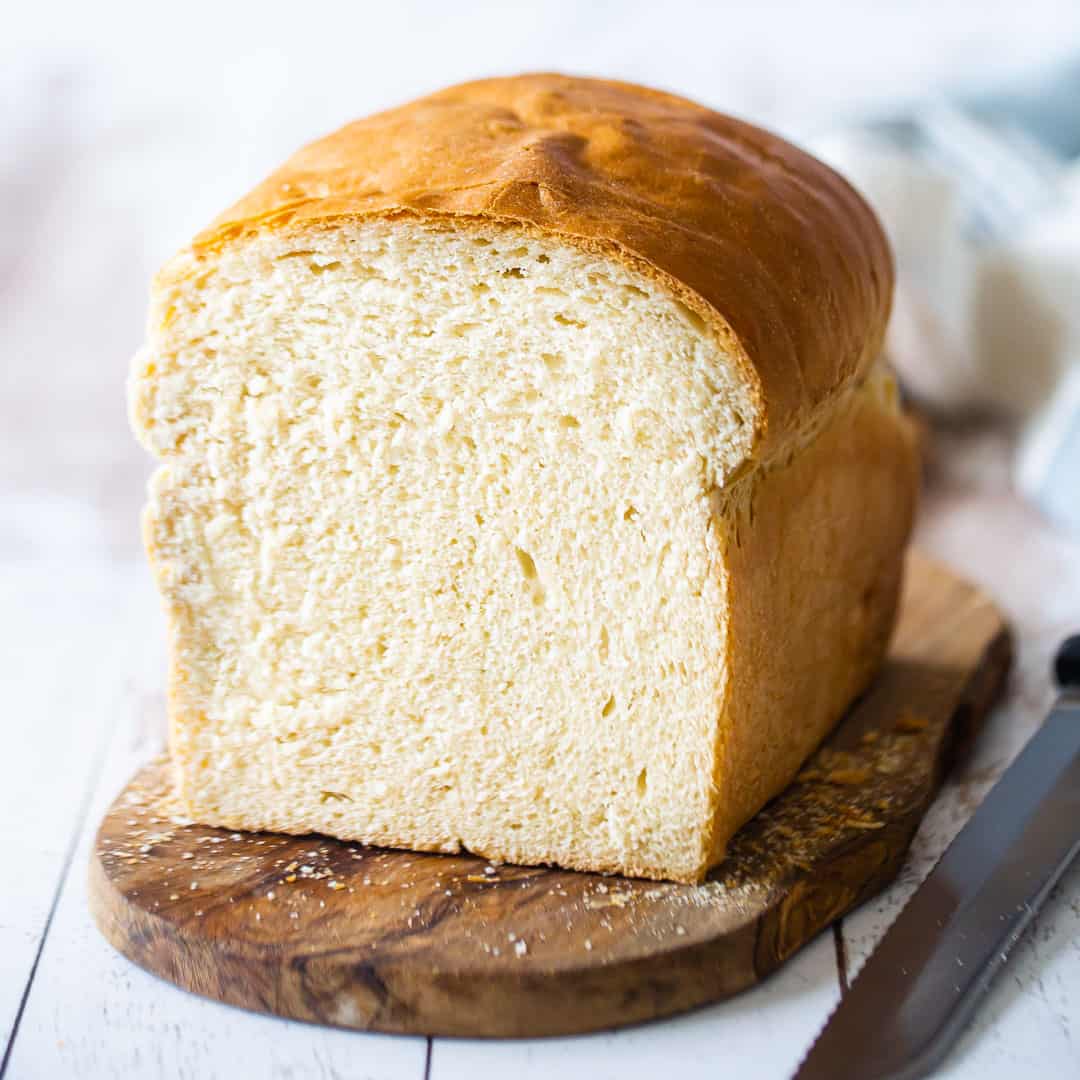
I am over the moon about that crunchy, splintery outer crust. See how it shatters? And the interior- soft, pillowy, and so airy. It's perfection.
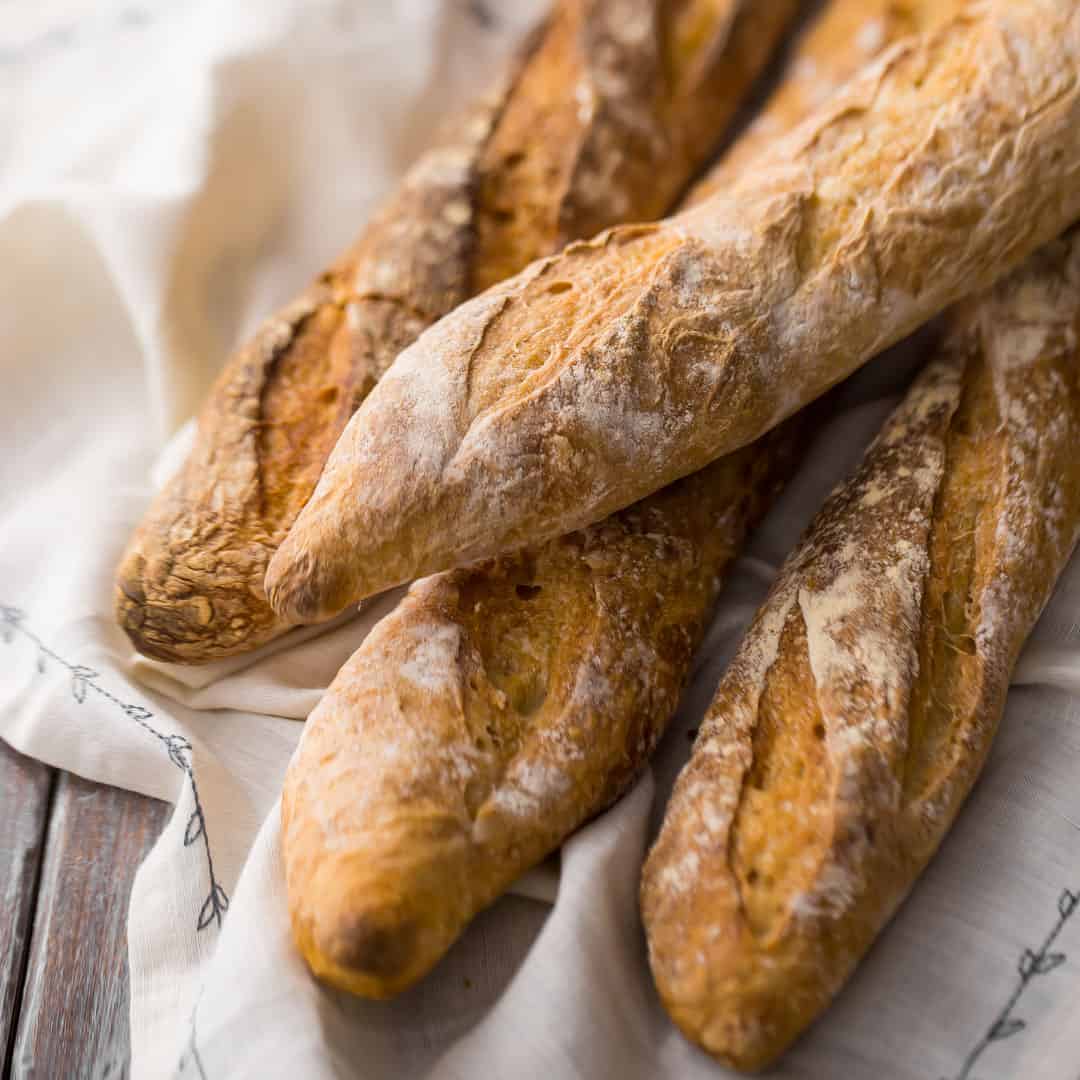
My family loves a good crusty French baguette. We eat this kind of bread with so many things! It's so chewy, yeasty, and good. I've always been a little afraid to try making it myself. Everything you hear suggests it's complicated and fussy, and only a French boulanger could ever get it right.
WRONG! Here's living proof that anyone can make a killer baguette.
Why You'll Love This Baguette
- Bakery-style at home: You don't need fancy equipment to get an artisan-quality loaf.
- Simple ingredients: Just flour, water, yeast, and salt.
- Crispy crust, tender crumb: For the perfect balance of crunch and softness.
- Versatile: Enjoy it as a snack, side dish, or as a base for sandwiches.
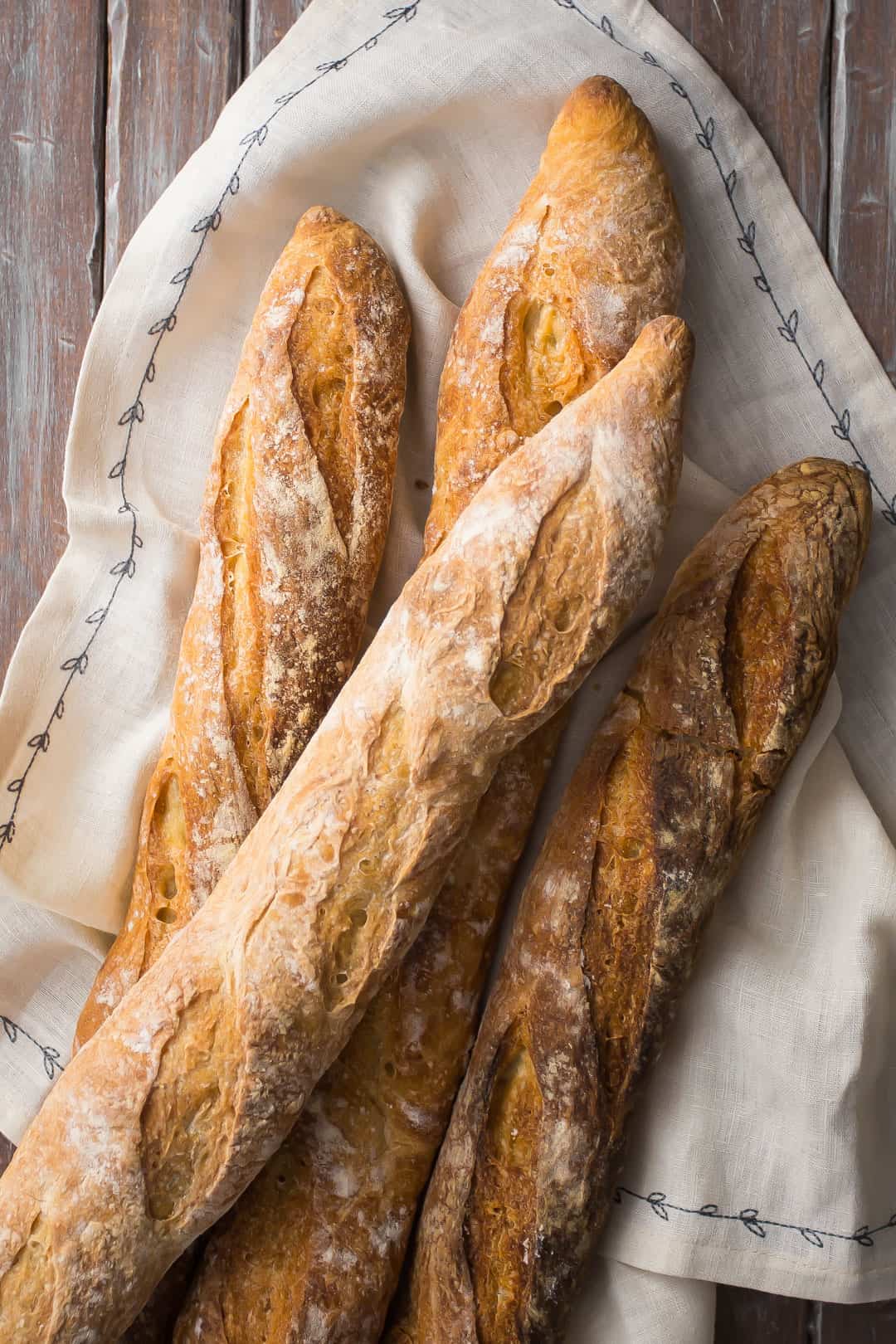
Ingredients You'll Need
The recipe card at the bottom of the post contains the full list with all of the amounts. Refer to that when you're cooking.
- Bread flour - Provides the higher protein content needed for that perfect chewy texture and airy interior.
- Kosher salt - Balances flavor and strengthens the gluten structure.
- Active dry yeast - The key to a good rise and light texture. Instant yeast can also be used.
- Water - Warm water helps activate the yeast, while cool water keeps the dough manageable.
- Additional flour - For dusting your work surface and shaping the loaves.
How To Make A Homemade French Baguette
Step 1: Start the Dough
Sprinkle the yeast over the warm water and let it sit until it becomes foamy. This ensures the yeast is active and ready to work.
In a large bowl, combine flour and salt. Make a well in the center and pour in the dissolved yeast. Slowly stir in cool water until you have a shaggy, stiff dough. You may not need all of the water. Cover and let the dough rest for 30 minutes.
Step 2: Fold and Rise
Turn the dough onto a lightly floured surface. Gently press it into a rectangle, then fold the sides into the center and flatten and rotate it. Repeat the process. Place the dough in an oiled bowl, cover it, and let it rise until it has doubled in size (about 1-2 hours).
Step 3: Shape the Loaves
Divide the dough into four equal portions. Shape each into a long, thin loaf, approximately 15 inches long, with tapered ends. Transfer to a parchment-lined baking sheet, cover loosely, and let it rise again until doubled in size (30-45 minutes).
Step 4: Bake with Steam
Preheat your oven to 450°F (230°C). Place a pan of water on the bottom rack to create steam, which helps form that signature crust.
Slash each loaf with a sharp blade, dust lightly with flour, and bake until golden brown and crusty, about 30-40 minutes. The baguettes should sound hollow when tapped.
Helpful Tips and Tricks
- Don't rush the rise: A slower rise develops more flavor and better texture.
- Use steam: That pan of water in the oven is the secret to a crisp, golden crust.
- Slash with confidence: Clean cuts help the bread expand properly in the oven.
- Cool before slicing: As tempting as it may be, let the loaves rest for at least 10 minutes to allow the crumb to set.

Classic French Baguette FAQ
This type of loaf is infinitely versatile! Slice it into ½-inch rounds and it's perfect as a base for bruschetta or crostini. Or it can be used as a dipper for your favorite party dip. And we love it toasted with garlic butter, for garlic bread. So good with a pasta dinner! Or just tear into it and eat it with a hot bowl of soup. So satisfying!
Baguettes are best when they're freshly baked, but they're still pretty darn great after a few days!
To store a French baguette, wrap it loosely and keep it at room temperature for 2 to 3 days. If you notice it's not as crusty after a while, just pop it in a warm oven (around 170 degrees-ish) for 5-10 minutes, and it should come out good as new.
A fancy French boulanger might not agree with me on this one, but I say go for it!
I do this a lot at my house. When the baguette is still fresh, slice it into thin rounds. I'll often cut on the diagonal so there is more surface area to spread yummy things on. Then, just slip the baguette slices into a zip-top freezer bag, and into the freezer they all go.
Whenever we want a slice of crusty French bread, we just pull out what we need.
The baguette slices thaw in just a few minutes at room temp. Alternatively, they can be warmed in the oven or toasted. It's super convenient!
Yes, but the texture won't be quite as chewy or airy. Bread flour is best.
No. A parchment-lined baking sheet works beautifully for this recipe.
This could be due to inactive yeast, cool rising conditions, or using too little water. Ensure your yeast is fresh and allow the dough plenty of time to rise.
Spritz the loaves with water right before baking, in addition to using a steam pan.
More Homemade Bread Recipes

Ingredients
- 3 ½ tablespoons (52.5 g) warm water
- 1 ½ teaspoons (4.67 g) active dry yeast*
- 3 ¾ cups (468.75 g) bread flour
- 2 teaspoons (12 g) kosher salt
- 1 ¼ cup (295.74 g) cool water, (you may not need all of the water)
- additional flour,, for dusting
Instructions
- Place the warm water in a small bowl and sprinkle the yeast on top. Set aside and allow the yeast to dissolve and become foamy.
- Place the bread flour into a large bowl and stir in the salt.
- Make a well in the center of the flour mixture, and stir in the dissolved yeast.
- Add the cool water, a little at a time, while stirring, just until a stiff, shaggy dough (watch the video below to see what this should look like) has formed (you may not need to use all of the water).
- Cover the bowl with plastic wrap and allow it to rest for 30 minutes.
- Transfer the dough to a lightly floured work surface, gently press it into a rectangle, and fold the short sides into the center. Flatten, turn 90 degrees, and repeat.
- Place the dough in a large oiled bowl, and cover with plastic wrap. Allow it to rise in a warm place until doubled in bulk (about 1 to 2 hours).
- Divide the dough into 4 equal portions, and shape each one into a long loaf (about 15-inches long and 1 ½-inches in diameter), with pointed ends.
- Place the loaves on a parchment-lined baking sheet, cover with oiled plastic wrap, and allow to rise until doubled in bulk (about 30 to 45 minutes).
- Preheat the oven to 450 degrees F, and place a pan of water on the bottom rack.
- Bake the breads until crusty and brown (approx. 30 to 40 minutes). The baguettes should give a hollow sound when tapped.
Notes
Author


Have a question about this recipe? Ask AI:
I add dehydrated onions and rosemary to mine excellent recipe.
That sounds delicious!
It was my first attempt at making the baguette and it broke from the side while baking. I don't know what went wrong, will you be able the help me rectify this?
Yes this happens as a result of steam trying to escape from inside the bread. If you slash the tops of the loaves as shown in the video, it will prevent this.
Today was my first baguette attempt. I am thrilled how they turned out. I need to work on my baguette form. My husband loves the bread’ Now I will work on the aesthetics of the dough in order to create a visually pleasing final product.
Tastes ok but after all that work and all those steps, I ended up with 4 breadsticks. The brief mention of dividing the dough into fewer than 4 pieces should be more like an instruction and less like an option. Do NOT divide this into 4 if you want something like a baguette you can have with a meal. Divide into just 2 before baking.
This is my go-to recipe for years and it has never failed me. I have it memorized, but I noticed you changed the US measurements. I usually use the metric system but it was easy because it was 1 lb of flour, 10 oz cool water and 1.75 oz warm water. I think this is do much easier than the cups. Would you kindly consider adding it back? ???
Oh, Donna, I'm so sorry you don't like it as much this way! I got so much negative blowback from readers about having to weigh... Do the metric weights not work as well for you?
Hi!! I would always rather it always be metric in any recipe, but the original measurements were easier than the cups. As I said, I have it memorized, but sometimes I refer back to your recipe. Thank you for considering. Great great recipe.
After years and years and hundreds of tries I absolutely love this recipe I added a couple of my own little things like seasoned salt and garlic oil and I only made two loaves instead of one but we ate the whole loaf three of us with butter it's so good I just wanted to have my friends over for bread and butter LOL what I'm wondering is can I take it to the folding put it in the fridge bring it out make it into Lowe's and then let it rise and when I say put it in the fridge I mean overnight ? Thanks for your help
So happy you like it! Yes, what I would do is take it to the shaping step. Then leave it in the fridge overnight. (Cover it lightly with greased plastic wrap.) It can stay there for up to 48 hours. Allow it to come up to room temp and double in bulk before you bake it off. Good luck!
I've failed at every attempt to make so many breads from scratch. I was searching for an easy beginners bread recipe and Allie's recipe was perfect. I read the reviews and used less salt and shaped the baguettes shorter. I followed all the other steps and set the oven to Proof. The bread looked perfect during each rise and the loaves came out of the oven beautiful. I had AP flour so I used that but I'll use bread flour next time. Thanks so much for such an easy recipe. I plan to make this bread often.
Do you have any recommendations for proofing this in the refrigerator overnight? Would you do it during the first proof or the second?
Yes I would do that for the second proof. Good luck!
I plan to use this recipe soon, I'm wondering if you have a higher yield measurement for this recipe. I'd like to feed around 20 people and I'm wondering if a x4 of this recipe would cover it. Can I do a x4 across all ingredients?
I'm afraid I haven't tested it that way so I can't say for sure. However, bread recipes tend to be more by feel than by numbers. So if you are a confident bread baker and you know what sensory cues to look for, then it's probably worth a try! Good luck and I hope you'll report back with your results!
I live at 5000 ft elevation. What might I do different at a high altitude for this recipe?
Hey there! I just did a quick google search for you and came up with lots of good results. I'd suggest giving a few of these articles a quick read. I'm afraid I'm not much of an expert on high altitude baking, but I'd trust any of these top few search results. Good luck; I hope this is useful info! https://www.google.com/search?q=high+altitude+bread+baking&rlz=1C1GCEA_enUS832US832&oq=high+altitude+bread+&gs_lcrp=EgZjaHJvbWUqBwgCEAAYgAQyBggAEEUYOTIHCAEQABiABDIHCAIQABiABDIHCAMQABiABDIHCAQQABiABDIHCAUQABiABDIHCAYQABiABDIKCAcQABiGAxiKBTIKCAgQABiGAxiKBTIKCAkQABiGAxiKBdIBCTExMTk2ajBqN6gCALACAA&sourceid=chrome&ie=UTF-8
Thank you so much! The link you provided took me to the King Arthur Flour article on high altitude baking guidelines. I have used the internet for tips on high altitude baking many times but this was the best and most informative I’ve found.
So happy I could help!
This recipe is amazing and tastes so great. I do have a question, my baguettes stay so small and thin. Can I only do 2 rather than 4? Or will they still turn out small even if I do 2?
Thank you!!
Yes you can shape them any way you like. Good luck!
Made it and it was excellent! So simple with great results
I made these and they turned out to be very nice. I used proper french bread flour brought back from France and saf-levure active dry yeast.
Oven temperature seemed a bit hot they were cooked in about 15-20 minutes but I managed to save them in time!
Just made tonight - PHE-NO-ME-NAL. I can't find decent baguettes where I live and had been craving a proper one for ages. This recipe is perfect. I made two large baguettes instead of 4, and we ate an entire one between the two of us for dinner, dipped in homemade tomato soup made with fresh roma tomatoes and basil harvested from our garden 🙂 thank you. will be bookmarking this one to keep forever.
I love this bread! My family couldn’t get enough! I’ll be making another batch tomorrow! Thank you!
When reheating bread that’s a little stale, wipe all the crust with wet hands, or mist it all over from a spray bottle. You’ll thank me later.
Great tip!
Thank you so much for this delicious recipe! My husband asked for a baguette with a crunchy crust and your recipe delivered!
So happy to hear that! Thanks so much for the positive feedback!