

Easy Homemade Puff Pastry Recipe
As an amazon associate I earn from qualifying purchases.
Leave those frozen sheets of puff pastry on the store shelf! This Homemade Puff Pastry is tender, flaky, and full of buttery flavor. Best of all? It comes together with just four simple ingredients and a few easy folds. There are no special tools and no complicated laminating process.
If you're baking savory tarts, sweet turnovers, or breakfast pastries, this shortcut puff pastry delivers that light, crisp texture we all love. Once you try it, you may never go back to store-bought again!

Puff pastry is the kind of thing that makes it feel like a special occasion. All those light, flaky layers and that rich buttery flavor!
But it's not the kind of thing you'd think to make yourself. I mean, it's just an ingredient you buy from the freezer section at the grocery store. Right?
Wrong! What if I told you you could make homemade, all-butter puff pastry sheets from scratch in your kitchen? And it only takes four ingredients and comes together in about 15 minutes?
It's true! This is the most delicious puff pastry you'll ever taste, and the best part is it's SO EASY to make. You'll never buy store-bought puff pastry again! This will become one of your favorite recipes!
Most puff pastry recipes tell you to start by combining softened butter with a bit of flour, then form it into a square encased in dough. There are a lot of steps: chilling, measuring, rolling, and folding. It can get very specific and precise, and to be honest, that stresses me out. I like it when things are a bit simpler and more intuitive.
I have cut back the number of steps and the time needed to make this easy homemade puff pastry.
The first time I made it, I couldn't believe how amazing it tasted, even though it was so easy to prepare. In other words, this is a shortcut recipe.
The result is almost identical to authentic puff pastry made the fancy French way, but the prep time has been cut down to about 15 or 20 minutes.
Here's Why You'll Love This Recipe
- No fancy equipment needed: Just a bowl, rolling pin, and a little counter space.
- Comes together in minutes: Only 15 minutes of active prep, plus chill time.
- Super buttery & flaky: Every bite melts in your mouth with rich, layered textures.
- Make ahead & freeze: Keeps beautifully in the fridge or freezer for whenever inspiration strikes.
Ingredients You'll Need
The recipe card at the bottom of the post contains the full list with all of the amounts. Refer to that when you're cooking.
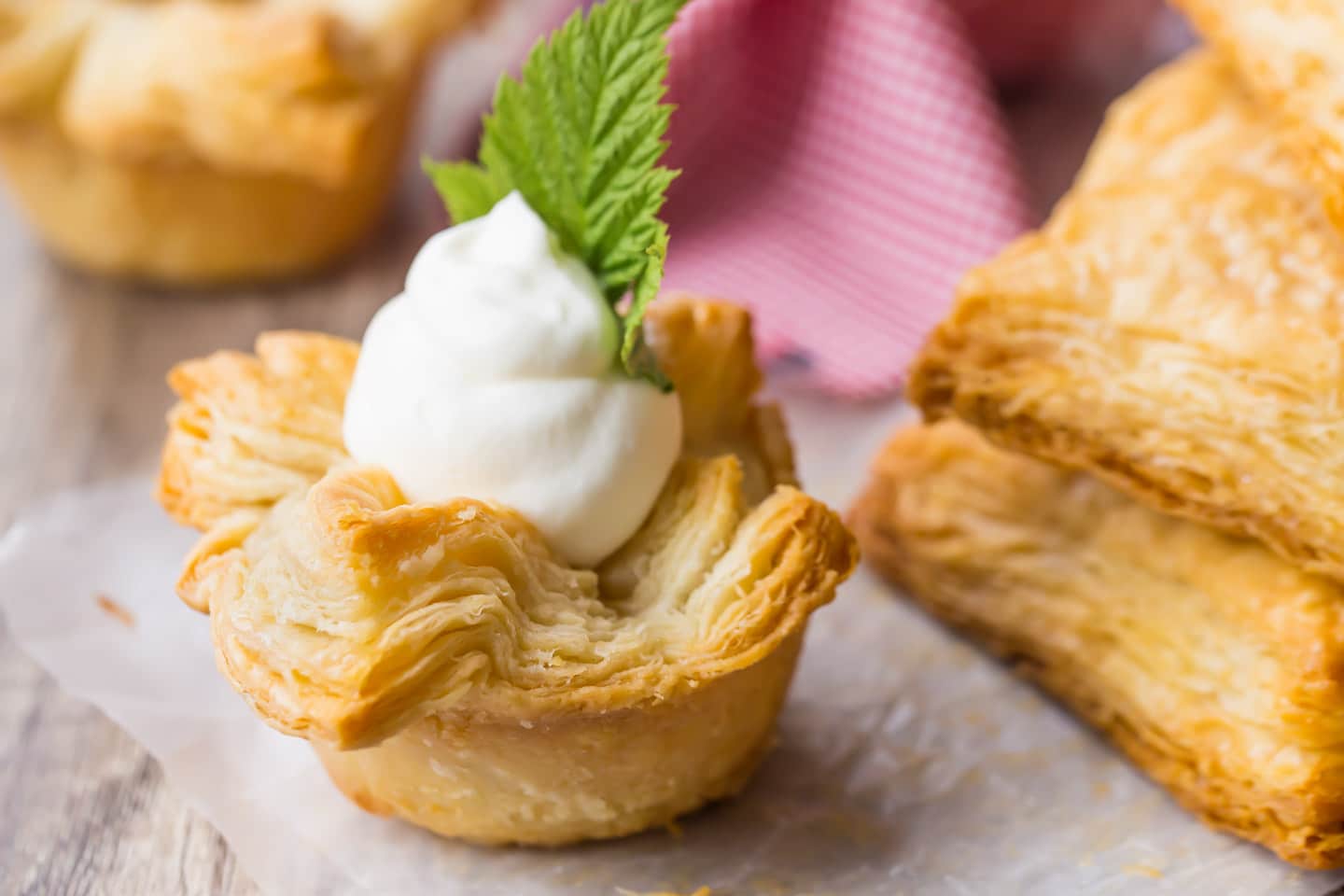
- All-Purpose Flour: You'll need 2 cups. When measuring, be careful not to pack the flour. To avoid this, spoon the flour into the measuring cup and use a knife to level off the top. Here's more info on the best way to measure your ingredients: How to Measure Ingredients for Baking. A gluten-free flour blend that can sub 1:1 for regular flour should work just fine if you'd like to make gluten-free puff pastry.
- Salt: Salt carries the flavors and intensifies them. The end result won't taste salty, but it will make everything so much more flavorful! I like kosher salt best because it doesn't contain any additives (table salt usually contains iodine, which can leave a bitter taste), so the flavor is pure, and it's very inexpensive and easy to find.
- Unsalted Butter: Make sure that the butter is cold. This will create excellent lamination. Cold butter also helps to reduce the time and steps involved in a traditional recipe. Without cold butter, your pastry will not flake into all those beautiful layers. I like to use unsalted butter because it lets me control the amount of salt in the pastry. For vegan or dairy-free puff pastry, use a plant-based butter that can substitute for dairy butter 1:1.
- Cold Water: Use cold water so the butter doesn't melt too quickly.
In Photos: How To Make Homemade Puff Pastry
Step 1: Mix the Dry Ingredients
In a large bowl, whisk together the flour and salt to evenly distribute.

Step 2: Add the Butter
Slice cold butter into ¼-inch pieces and toss with the flour mixture to coat. Don't overwork it! You want visible chunks.

Step 3: Bring It Together
Stir in the cold water until a shaggy dough forms.

Step 4: Shape and wrap
Shape into a ball, then flatten into a disk.
Wrap tightly and chill for 1 hour in the fridge, or 20 to 30 minutes in the freezer.

Step 5: Roll & Fold
Unwrap the dough and place it on a lightly floured surface. Roll into a rough rectangle. Fold into thirds like a letter. Rotate 90 degrees, then repeat the roll-and-fold process. Do this 2 to 4 times in total for lots of flaky layers.


Step 6: Chill Again
Wrap the dough tightly and chill for at least two more hours, or overnight.
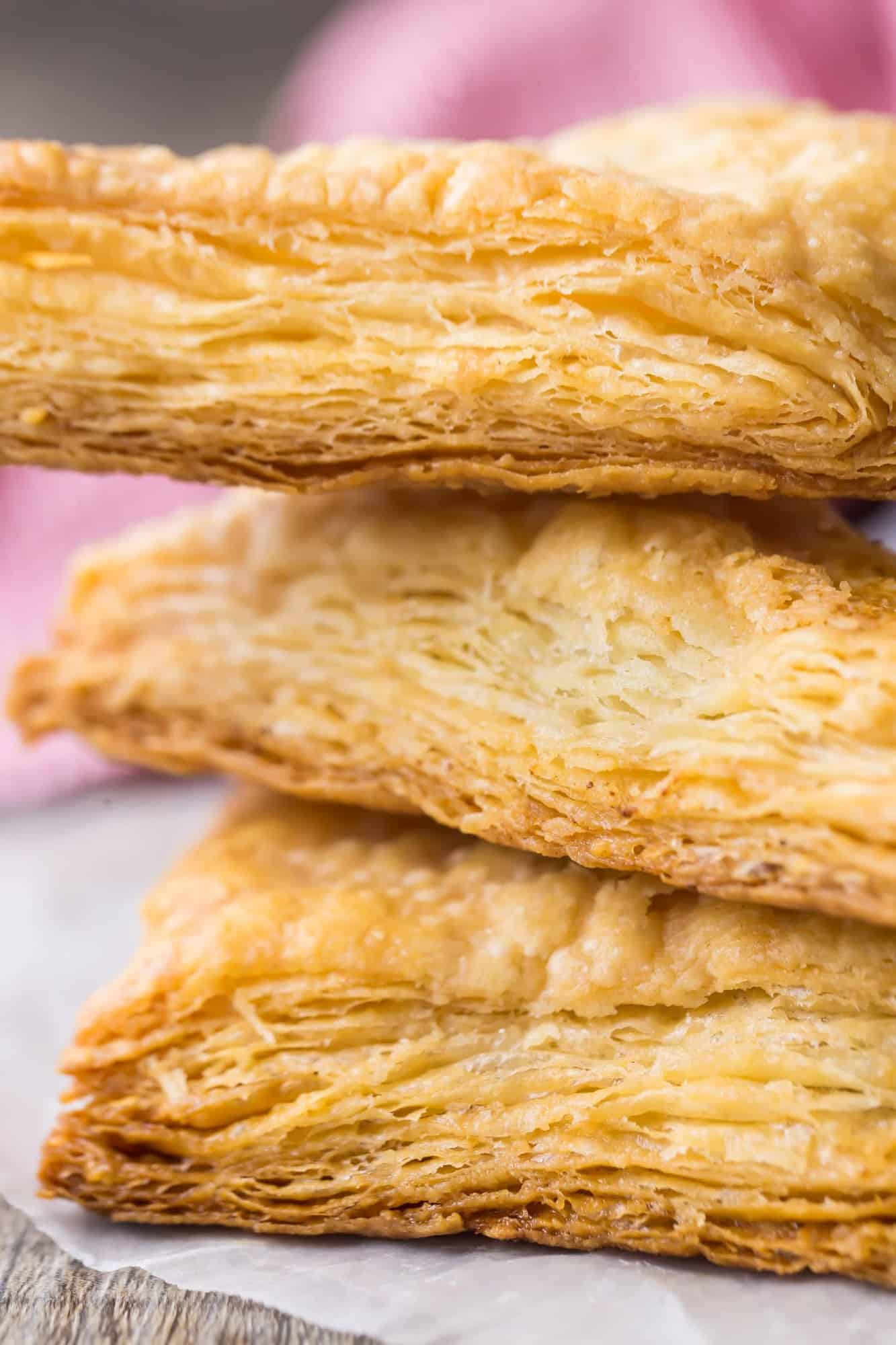
Helpful Tips and Tricks
- Keep everything cold: Cold butter = flakier layers. If the dough gets too soft, pop it back in the fridge.
- Don't overwork the dough: You want to see big streaks of butter - that's where the puff comes from!
- Egg wash before baking: A quick brush with beaten egg and water gives the pastry a glossy, golden finish.
- Hot oven, cold dough: Always start with a fully chilled pastry and a preheated oven for the best rise.
How To Use Puff Pastry
Savory Recipes
- Cut the pastry into long strips, sprinkle with grated cheese, twist, and bake for cheese straws.
- Wrap strips around sausages or mini hot dogs for the best sausage rolls/pigs in a blanket.
- Cover a small wheel of brie or camembert with pastry for a brie en croute, aka baked brie.
- Make little tarts or cut rounds and top with mushrooms, spinach, and/or onions for a savory appetizer or pizza.
- Use to top a chicken pot pie.
Sweet Recipes
- Cut into squares, top with apple pie filling, and fold into apple turnovers.
- Bake puff pastry dough and sandwich it around whipped cream, pastry cream, and fruit for Napoleons.
- Sprinkle with cinnamon sugar and brown sugar, roll into a tight "C," cut into slices, and bake the elephant ears, aka palmiers.
- Roll around a fruit/cheese filling to make a strudel of sorts.
- Sandwich around jam for homemade Pop-Tarts.
- Cut into rings and fry in hot oil for the most incredible donuts!

Puff Pastry FAQ
Anything from sweet treats like turnovers and tarts to savory recipes like hand pies or cheese straws.
Absolutely! Wrap it tightly and freeze for several weeks. Thaw in the fridge before using.
This makes roughly 24 ounces (685g) of dough, about the same as two standard store-bought sheets.
Nope! This recipe is designed to be made by hand, keeping it simple and accessible.
Yes, there are four different types of puff pastry: half, three-quarter, full, and inverted. The different types are based on the proportion of fat weight to flour weight. Full is equal parts fat and flour. Three-quarters denote three-quarters of the weight is fat, to one-quarter flour. Inverted puff pastry is when the dough is encased in the butter, rather than the butter encased in the dough, which is the traditional way.
Storage and Freezing Tips
- Make the puff pastry at least a day before serving it.
- Puff pastry kept in the refrigerator will keep for several days.
- Keep it in the fridge tightly wrapped in plastic wrap.
- To freeze it, wrap it tightly in plastic wrap and place it in a sealed freezer bag.
- It will keep in the freezer for up to one month.
- When ready to use the frozen pastry, transfer it from the freezer to the refrigerator to thaw overnight. Keep it folded together and wrapped in plastic wrap while thawing.
More Recipes To Try
- Baked Brie in Puff Pastry
- Apple Galette
- Caramel Apple Cream Puffs
- Cream Puff Cake
- Challah Bread
- Baklava

Ingredients
- 2 cups (250 g) all-purpose flour
- 1 teaspoon salt
- 1 ¼ cups (283.75 g) unsalted butter, (2 ½ sticks), cold
- ½ cup (118.29 ml) cold water
Instructions
- Place the flour and salt in a large bowl and whisk to combine.
- Cut the cold butter into ¼-inch slices and add to the flour mixture, tossing to coat.
- Stir in the cold water until a thick dough forms.
- Gather the dough into a ball, flatten it into a disk-shape, and wrap in plastic wrap.
- Chill for 1 hour in the fridge, or 20 to 30 minutes in the freezer.
- Unwrap the dough, dust the work surface with flour, and roll the dough into a rough rectangle shape.
- Fold the dough in thirds, like a letter.
- Turn 90 degrees, roll and fold again.
- Repeat about 2 to 4 times, wrap the dough in plastic wrap, and chill for 2 hours or overnight.*
Notes
- Brush the pastry with an egg beaten with a couple of teaspoons of water before baking for a beautiful sheen.
- When you're ready to bake the pastry, make sure it is COLD and the oven is HOT.
- Bake times will vary based on exactly what you are making, so follow your recipe!
- The dough can also be frozen. It will keep for several weeks in the freezer, tightly wrapped. Thaw in the refrigerator.
- This recipe makes approximately 24 ounces, or 685 grams, of dough.
Author

More Simply Perfect

Have a question about this recipe? Ask AI:
Used this recipe and it works great. Has anyone every used fine ground flour (cake flour)?
Wow, so easy to make. Thank you for the detailed recipe. Your photographs speaks a lot.
This recipe is incredible! Thanks for sharing it! I am very comfortable with my short crust pastry, but my husband is from Europe and he loves savory cheese pastries with puff pastry. I used your recipe to make it and it turned out fabulous! Thank you!!
Is 1/2 cup water the correct amount? It took me approximately twice that to get the dough to come together (no, I’m not at altitude), and now that I see the video, it looks like a lot more than 1/2 is going in there as well. Thank you!
Yes, that's definitely right! I always use that amount when I make this recipe, and it's what I've added in the video as well. I double-checked and it's right- I'm using my 1 cup liquid measure and it's half full. Also there are tons of comments from other readers who have made it this way and been really happy with the result. I would continue working that dough until it comes together. It may take some doing!
Tried this today. Followed the exact measurements and procedure. I find rolling the dough so messy since the dough and butter keeps sticking to my rolling pin even after dusting the dough with flour. Can I keep adding flour as much as I want? Will that affect the dough in any way? TIA
No problem! Definitely add as much flour as necessary to prevent sticking. It will also help in forming the layers. Good luck!
I very much enjoyed this primer on puff pastry. I had Googled the question: Do people make their own puff pastry? Not only was my question answered, I am now fully primed to make my own.
Hi there - started making this using the metric measurements and needed alot so just doubled all the quantities given but seems like something was off - the recipe when using in metric says to use more butter (283g) than flour (250g) but going to the American system it says to use much less butter (1 and 1/4 cups) in comparison to to flour ( 2 cups) so now feel I may have gotten this very wrong and wasted a lot of ingredients
Please remember that butter weighs more than flour so if you are looking at a volume quantity next to a metric quantity they will look very different!
I made your very simple puff pastry last night. I have to admit I was skeptical because I had made puff pastry years ago from another complicated recipe that had to be carefully timed between rollings and it took hours and hours, ugh.
I made Danish this morning with half of the dough from your recipe. I didn’t use all the dough because I didn’t want to waste all the ingredients for the Danish if the dough didn’t work out?
Holy moly, yummmmy. Your recipe is the best and easier then even going to the store to buy ready made puff pastry!! Thanks for the fantastic albeit easy puff pastry recipe!
Easy, delicious, and flaky. This pastry reminded me of late grandmother’s crust. I have never bought puff pastry and never will. I made four crusts over the course of several days and froze a little extra. Needless to say this accompanied both an apple & peach tarte tatins and did not last long in my house. Don’t be afraid of this crust give it a try.
Hi,
I never leave comments, but here I need to say something: thanks for this great recipe!
It brought the years passed in France to Venezuela, where I leave now with my family.
Saludos
Hi!
This recipe looks great! I have been reading a lot of recipes, and they have 4 hour chilling periods between each "two-fold" set. Wonderful that you have offered another option.
I have a question. I need to make the puff pastry gluten free, so I was going to use a GF Pie Crust Flour. Would that work in your recipe?
Thank you!
Erica
I haven't tried that so I can't say for sure- but if it's a blend that says it can swap for regular flour 1:1, then I would think it should work! Good luck!
This recipe works so well no one would be able to tell the difference between this one and the one you get in the store (in fact, this was tastier)- of course, without all that fuss, energy, and trans fat! Thank you for this recipe. It's a keeper.
O M G !! This is an amazing recipe! I was afraid to try it, figuring I would fail. I have always bought puff pastry from the store. NEVER again! I did use the food processor to mix the butter and flour mix, but next time I won't bother. (It is hard to wrap your mind around butter that is not mixed 🙂 I folded it about 6 times, and let it rest in the fridge over night. Rolled it in the morning, and baked at 400. Perfection! Thank you!!
Hi there!
Thank you for this recipe which I made today. The pastry flakes beautifully and the laminated layers work really well too. I have a question though; there are a few tough gritty bits here and there in the cooked pastry and I wonder if it is because the flour isn’t completely hydrated what do you think?
Hi! Thanks for the recipe. I made it a couple of days ago and filled it with a yummy savory filling. I'm an experienced bread and dough baker, however this was my first time making puff pastry. I used Kerrygold butter. I felt like the dough was far too wet with so much butter. I know that (really cold) butter is one of the most important parts of making successful puff pastry, but even taking lots of caution to keep it very cold, I had trouble rolling the dough because the butter was so thick in all the dough. It stuck to my generously floured countertop and rolling pin even after 24 hours refrigeration. I cut it to the 1/4 inch thickness suggested. I followed the recipe exactly. The dough was delicious, but it did leak butter terribly in my recipe. I will definitely try it again, but I wonder if you have any suggestions on how to improve the turn out?
Hi - is there a rule of thumb of how thick the dough should be when you roll it out? i.e. to make a tart? or turnover? also for the leftover pieces of dough can we roll it and cut again or do we need to go through the folding process?
thank you!
You can roll it as thick or as thin as you like. I generally do anywhere from 1/4-inch to 1/8-inch. Remember it puffs up a lot as it bakes! Sadly I would not recommend re-rolling scraps- it just doesn't work well.