

New York Bagel Recipe
As an amazon associate I earn from qualifying purchases.
My homemade New York Bagel Recipe is simple and produces bakery-style bagels right at home with no special equipment needed!
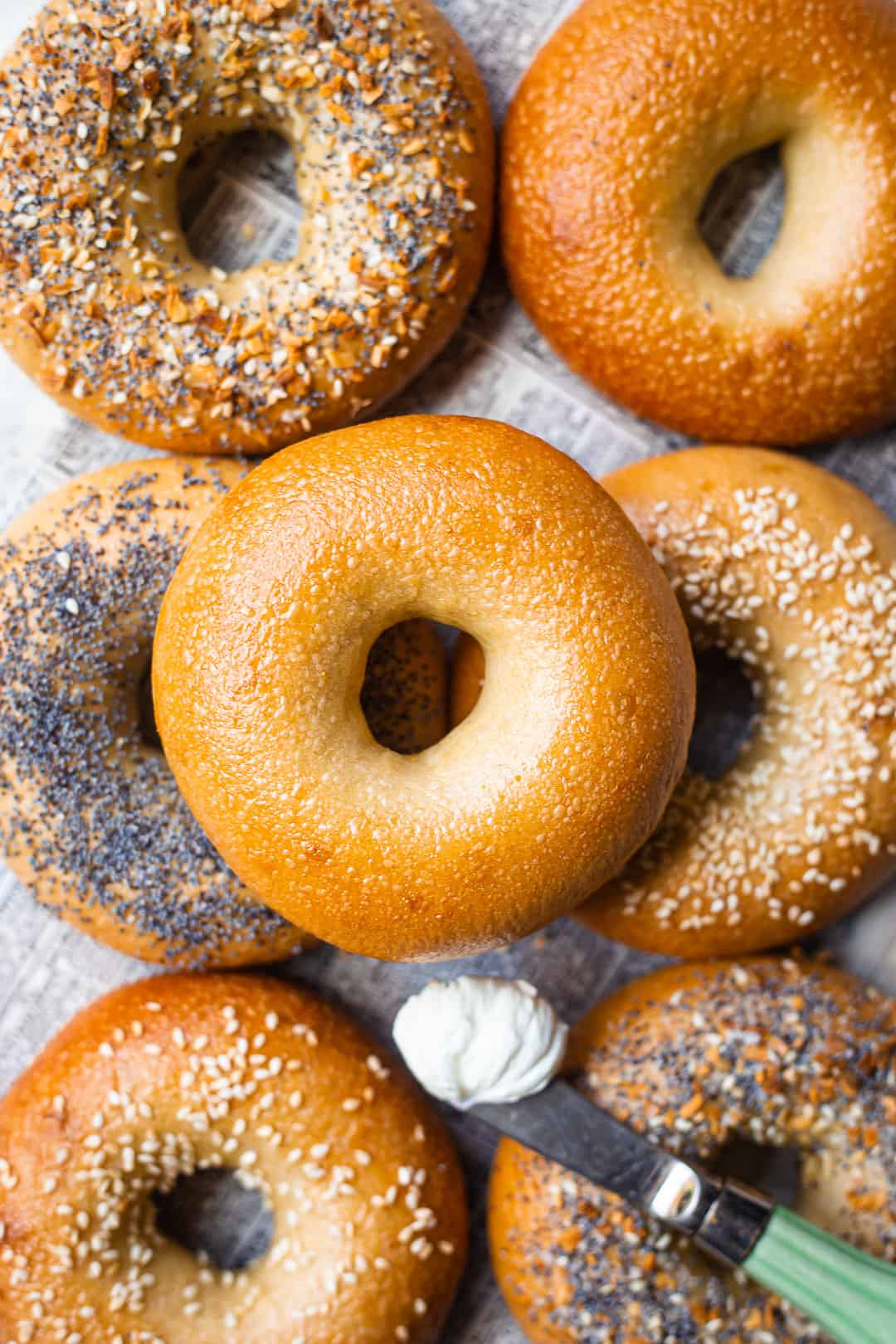
Have you ever had a New York bagel? New York is famous for its bagels. They are chewy and flavorful, with a blistered, crusty exterior. They're soft and yeasty in the middle, and they taste great with cream cheese and all the fixings (more on that below!). Next time you're there, be sure to grab one for breakfast, with a nice, tall cup of hot coffee. It's pure bliss!
However, if you can't get to NYC anytime soon, don't worry. This homemade bagel recipe is every bit as good. You can make it from ingredients you probably already have in your pantry; it's not at all difficult, and it's a fun way to spend an afternoon.
Even better, the next day you'll have freshly baked bagels coming out of your oven! And you won't believe how great these taste.
Chewy, shiny, and golden with that signature crisp crust and tender interior, New York bagels are iconic for a reason. The best part? You can absolutely make them right at home! With just a handful of pantry staples, a little time, and a few pro techniques, you'll have a batch of freshly baked bagels that rival the best delis in the city.
Let's walk through every step so you can master these bakery-style beauties from your own kitchen.
Here's Why You'll Love This Recipe
- These New York-style bagels have that authentic chewy texture and rich flavor you love, thanks to a slow, overnight rise that develops depth and character.
- They come together with just a few basic ingredients that you likely already have on hand.
- The dough can be made ahead, allowing you to enjoy freshly baked bagels with minimal effort in the morning.
- They're incredibly customizable with your choice of toppings or left plain for a classic touch.
- And because they freeze beautifully, you can stock your freezer and always have a delicious bagel ready to toast.
Ingredients You'll Need
There are a lot of recipes out there that call for weird specialty ingredients like diastatic malt powder, high-gluten flour, and barley syrup. You won't find any of that in this bagel recipe. I wanted to make this easy, so anyone who's not a professional baker can feel comfortable making bagels.
The recipe card at the bottom of the post contains the full list with all of the amounts. Refer to that when you're cooking.

- Cool water: Helps hydrate the dough slowly, resulting in better texture and flavor development.
- Honey: Adds a subtle sweetness to the dough and enhances browning when added to the boiling water.
- Active dry yeast: Leavens the dough, creating those signature airy pockets inside.
- Flour: Bread flour is ideal for chewiness, but all-purpose flour works, too.
- Kosher salt: Enhances flavor and strengthens the dough structure.
- Cornmeal: Keeps the bagels from sticking to the pan and adds a bit of texture.
- Water for boiling: Essential for the traditional boil that gives bagels their chewy crust.
- Baking soda: Alkalizes the water, which helps the bagels brown deeply in the oven.
- Egg wash: Gives the bagels a beautiful shine and helps toppings stick.
- Optional toppings: Sesame seeds, poppy seeds, minced onion, or coarse salt for extra flavor and crunch.
In Photos: How To Make Homemade New York Bagels
Step 1: Proof The Yeast
Start by adding the cool water to a large mixing bowl. Stir in 1 tablespoon of the honey. Sprinkle the yeast over the surface and let it sit for 5 to 10 minutes, until foamy.


Step 2: Add The Flour
Add the flour and mix until you get a stiff, shaggy dough.


Step 3: Add Salt & Knead
Add the salt and knead until the dough becomes smooth, elastic, and passes the windowpane test (about 15 to 20 minutes of kneading by hand).

How To Do The Windowpane Test
Pinch off a small piece of dough and, using your fingertips, gently stretch it outward from the center. You should be able to pull it tissue-thin without it tearing. It should be so thin you can see light passing through it, just like a windowpane.

Step 4: Shape the Bagels
Divide the dough into eight equal portions. Roll each into a smooth ball, keeping the others covered to prevent drying.
Place the dough balls onto a parchment-lined, cornmeal-dusted baking sheet. Cover and let them rest for 5 minutes.
Use your thumb to poke a hole in the center of each ball, then gently stretch to form that classic bagel shape.


Return the shaped bagels to the baking sheet, cover loosely with greased foil, and refrigerate overnight (12 to 18 hours).

A long, slow nap at a cool temperature will allow the flavors to really develop. This is called "retarding," and it slows down the yeast fermentation, allowing the natural bacteria to produce acids that give the bagels a more complex flavor, and allowing those signature "fish eyes" (also known as tiny blisters on the surface) to form.
I would recommend completing everything up to this point by late afternoon/early evening. That way, you can wake up and finish baking your bagels first thing in the morning.

Boil and Bake
Preheat your oven to 450°F. Bring 1 ½ gallons of water to a boil and add the remaining tablespoon of honey and the baking soda. (It may foam up briefly.)
Boil the bagels for 20 seconds per side, then transfer them to a wire rack to drain.
Move them to a lightly greased, parchment-lined baking sheet. Brush with egg wash and sprinkle with toppings, if desired.
Bake for 12 to 18 minutes, or until golden brown and blistered.
Helpful Tips and Tricks
- When I make any kind of bread, I use active dry yeast. It's fine to substitute with the same amount of instant yeast if that's what you have on hand.
- If you'd like to use sourdough starter in place of the yeast, use 1 cup of starter and subtract ½ cup of water and ¾ cup of flour to compensate for the water and flour in the starter (source: How to Convert Recipes to Sourdough).
- If you'd like to use fresh yeast instead of dry, you'll need about 0.6 ounces for this bagel recipe.
- The higher the protein level in your flour, the chewier your bagels will come out. Many bakers reach for bread flour for recipes like this one, and it's a great choice since it's got around 3 to 4% more protein than all-purpose. This results in stronger, more developed gluten structure and a really satisfying texture.
Bagel Toppings
Check your cupboard; if you have:
- Sesame Seeds
- Poppy Seeds
- Dehydrated Minced Onion
- Coarse Salt (like kosher salt or sea salt)
... then you can make your own everything bagel seasoning. Just mix about 2 tablespoons of each of these ingredients in a small bowl, and there you have it.
Egg wash is optional, but I really think it makes these bagels extra-pretty. It gives them a glossy look, and allows them to become deeply golden-brown as they bake.
If you're using egg wash, brush it on before adding your toppings. If not, just sprinkle the toppings right on the boiled bagels. They will feel a little sticky from the boil, and the toppings will adhere beautifully.
How To Serve Homemade Bagels
There are so many delicious ways to enjoy a bagel! I especially love them split horizontally, toasted, and topped with cream cheese and a slice of fresh tomato. But really, the sky is the limit!
Here are a few other ideas, if you're thinking of doing like a DIY bagel bar or something swanky like that:
- Butter
- Cream cheese
- Smoked salmon, aka: lox
- Thinly sliced red onion
- Capers
- Fresh dill
- Thinly sliced tomato
- Fresh sliced cucumber
- Fresh sliced avocado
- Scrambled or fried egg
- Bacon, sausage, or ham
- Any kind of cheese
- Peanut butter or almond butter
- Honey
You could also make pizza bagels! These are always a big hit. Just spread on a little pizza sauce and add shredded mozzarella and pepperoni slices, then pop them into the oven until melty and delish.
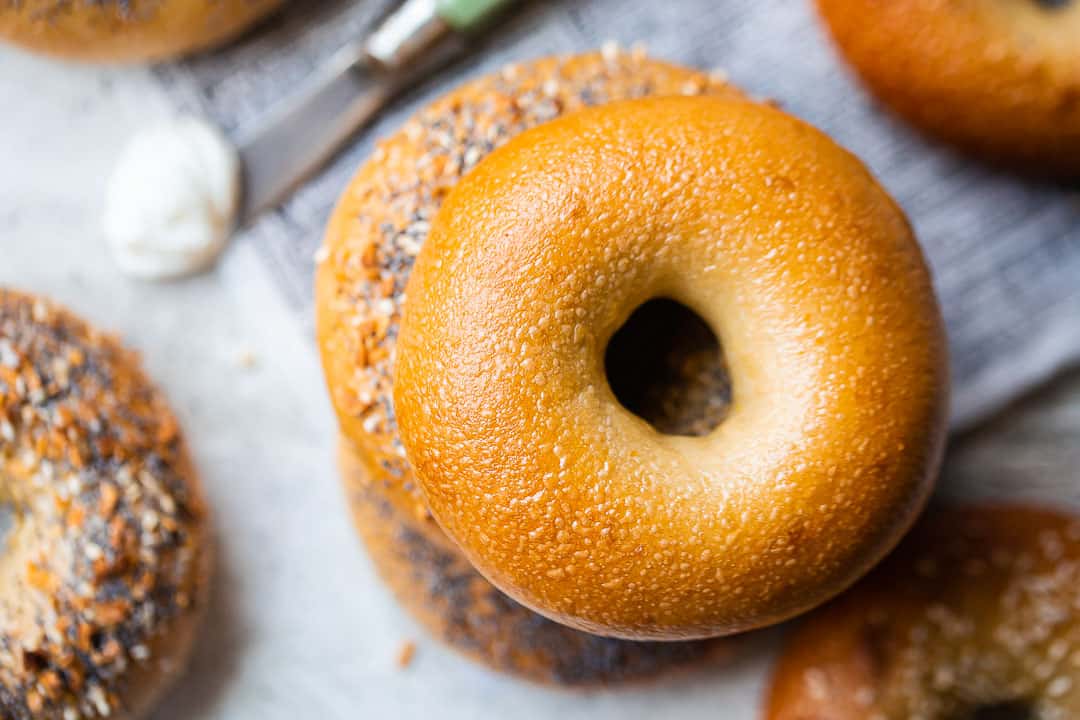
You can make this dough, shape the bagels, and freeze them on a tray. Once they're frozen solid, transfer them to a zip-top freezer bag, and they will be good in the freezer for 2 weeks.
When you're ready to bake them, place them on a parchment-lined, cornmeal-dusted tray (covered) in the fridge and allow them to thaw and slow-ferment as usual. Then, continue with the recipe from there.
Once they're thoroughly cooled, slip your bagels into an airtight bag, and they will last at room temperature for a few days. After that, pop them into the fridge and they should keep for about a week or two.
Homemade bagels, like most breads, freeze beautifully. If wrapped tightly, you can expect your bagels to last for up to 2 months in the freezer. Thaw them at room temperature or in the fridge before serving.
More Homemade Bread Recipes
- French Baguette
- Homemade Croissants
- Soft Whole Wheat Bread
- Sticky Buns
- Pizza Dough
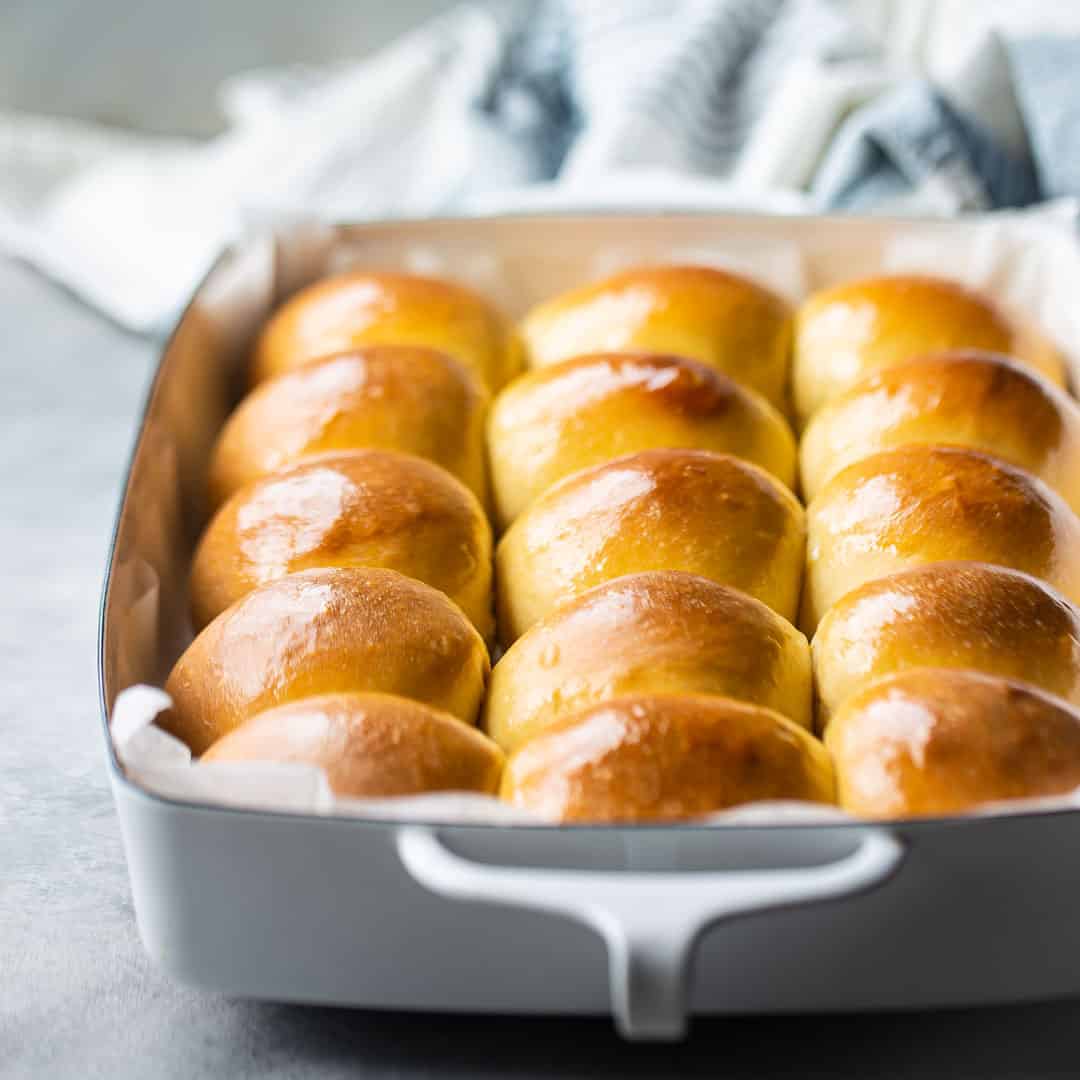
- Hawaiian Rolls
- Soft White Bread
Ingredients
- 1 ¼ cups (295.74 g) cool water , (around 80 degrees F)
- 2 tablespoons (29.57 g) honey,, divided
- 1 packet (7 g) active dry yeast* , (¼ ounce or about 2 teaspoons)
- 4 cups (500 g) flour , (bread flour OR all-purpose flour; approximately, you may need slightly more)
- 2 teaspoons (9.86 g) kosher salt
- cornmeal, (for dusting the pans)
- 1 ½ gallons (5678.11 g) water
- 1 tablespoon (14.79 g) baking soda
- egg wash, (one large egg beaten with a few teaspoons of cool water)
- sesame seeds, poppy seeds, dehydrated minced onion, and/or coarse salt, (optional garnish)
Instructions
- Place the cool water in a large bowl and stir in 1 tablespoon of honey.
- Sprinkle the yeast on top and allow it to dissolve. (After about 5 to 10 minutes, the mixture should start to look foamy.)
- Stir in the flour, mixing until a stiff, shaggy dough forms.
- Add the salt, and knead the dough until it gathers into a ball and becomes smooth and elastic.
- Continue kneading the dough until it passes the windowpane test** (about 15 to 20 minutes).
- Divide the dough into 8 equal portions, rolling each one into a smooth ball. (Cover the dough as you're working so it doesn't dry out.)
- Place each ball of dough on a parchment-lined baking sheet that's been generously dusted with cornmeal, cover, and allow to rest for 5 minutes.
- Using a thumb or finger, poke a hole into the center of each ball of dough, then stretch the hole wider to form the bagel shape.
- Place the shaped bagels back onto cornmeal-dusted, parchment-lined baking sheets, tent with lightly greased foil, and refrigerate for 12 to 18 hours.
- Preheat the oven to 450 degrees F, bring the water to a rapid boil, and add the remaining honey and the baking soda (the water will foam up briefly).
- Gently place the bagels in the hot water, allowing them to boil for 20 seconds on each side.
- Carefully remove the bagels from the hot water with a spider or slotted spoon, allowing them to drain on a wire rack.
- Transfer the bagels to a baking sheet that's been lined with lightly greased parchment paper.
- Brush them lightly with egg wash and sprinkle on toppings (if using), then bake until golden brown and blistered (approximately 12 to 18 minutes).
Notes
Author


Have a question about this recipe? Ask AI:
If using granulated sugar should the water be increased by 2 Tbs? I kneaded for a very long time by hand and the dough still wouldn't pass the windowpane test.
Hey Debbie! I'm not sure if using sugar vs. honey would make that difference. That said, if your dough feels stretchy and elastic then you've probably done a good job. The windowpane test is just like that added insurance, kwim? I'd say go ahead and bake them up. If they come out crumbly then you'll know the dough wasn't kneaded enough. But a good 10 to 15 minute knead should be plenty.
1/4 oz of dry active yeast is 2 1/4 tsp. Also, if the dough is not passing the windowpane test and you used a high gluten flour you may want to let it rest for 5 minutes and try again once the gluten has had a chance to relax some.
Thanks for chiming in- that's excellent advice!
I like this recipe a lot, and I make it often. However, I don’t know why but I’ve never been able to get to the windowpane stage. I’ve tried the kitchenaid entirely, half kitchenaid, half by hand, and today I kneaded for a full 20 minutes by hand. Not even close to windowpane. If you have recommendations, please share. My wrists hurt ?
Perhaps you might want to try using bread flour. At the time this recipe was published, we were in the throes of a pandemic and it was hard to come by. But you should be able to find it pretty easily now!
Hello, love your bagels ! Can I ask if I can add blueberries into the bagel for a purple sheen ? If so how do I go about it ?
Hey that's great! Yeah I'm sure you could add just about anything to the dough. I'd probably suggest frozen blueberries, and just knead them right into the dough. Good luck I hope you get the result you're after!
I have to tell you I was skeptical at first but I must tell you this recipe was excellent thank you so much for sharing. My bagels were delicious.
I'm so happy it worked out for you. TYSM for the 5-star review!
I'm fixing to start this recipe and find I only have instant yeast. I know you said use the same amount as the active. What I'm not sure of is if I need to proceed with the process of dissolving the yeast in the water and honey or just add it to the dry ingredients. Help! I've been itching to make this recipe and today's the day. Well, if you answer in time. Lol
Hey there~ I don't think I got this in time; so sorry! But the truth is I really don't know that it matters a whole lot. I'd probably still dissolve it but you could add it to the dry and it would likely still work just fine.
Mine aren’t as fluffy as I’d like. What did I do wrong?
It could have to do with the rise times. This can happen if they're not given enough time OR if they're given too much time. You want to keep a close eye on them. They're ready for the next step when they've grown to twice their original size.
I just took my bagels out of the oven and they are beautiful!! Best recipe I have tried.
No more store bought bagels! I have baked this recipe four times and every time they came out beautifully. A bit of trial and error to be honest but I love this recipe. Overnight dough makes the process much easier by dividing kneading part and baking part. Thank you Allie!!
You're very welcome! Thank YOU for the 5-star review!
I am obsessed with these bagels. They have turned out so well, each time. I think I have made at least 4 batches by now. Tonight will be #5 ( well, make tonight- boil/bake in the morning).
A few hints for newer bakers, I choose to use bread flour, make sure my yeast is fresh and I don't add ALL the flour at first, but start with 3 Cups and gradually add the final to the 'perfect' bread dough. You may not need the entire 4 cups, which may make them dry.
The only change I made, was to boil my bagels about 1 minute each side and I have had great luck. I do not use eggs, and don't miss the egg wash at all. I sprinkle with sesame seeds or the 'everything' mix, and bake. Perfect bagel denseness. They freeze well too. Thanks for posting.
TYSM for the tips and for the great feedback!
I just made these for the second time and both times, the dough was so incredibly tough and dry, I wasn’t ever able to get it to the window pane level of stretching. I left it to knead for 30 mins in the kitchen aid and after that it still was too tough so I kneaded by hand and nothing 🙁 I’m not sure what I’m doing wrong because I followed every step to a T! Do I need to add more water? Less flour? The dough just seems soooo dry
Hey Sarah! I'm so sorry you had trouble! It should be a pretty stiff dough but if yours seemed excessively dry and never gathered itself into a ball, etc. then I'd say go with your gut and add a little more water. The flour/water balance can be unpredictable with many bread recipes...
Can this recipe be double or tripled? Or would the measurements change if doubling or tripling?
I haven't tried so I can't say for sure, but please feel free to experiment!
My bagels looked perfect when they came out of the fridge, but when I boiled them as directed they deflated and became so flat 🙁
What did I do wrong? If my water wasn’t cold when I added the yeast, could this have been it?
When they've just proofed and they're full of air, you just have to handle them very carefully. I think it's more likely due to just being a little too rough with them and letting all the air out. I'm so sorry that happened to you!
Hey, I love this recipe and write-up. Bagels should definitely be rested overnight in a refrigerator so it's great you mentioned that. I do really like adding barely malt syrup to my bagels as it adds flavour and colour. In the UK it's a fairly easy ingredient to find and I've added a tablespoon or more before mixing my dough. Bagels can be a little bland in flavour otherwise. I like use a little baking soda in the boiling water as it adds a little bit of crispness to the finished bagel - is that right?
Thanks again!
Where does the other divided half of honey and the baking soda come in? Before or after flour is added?
Check out step #10 of the recipe instructions.
Absolutely fantastic recipe. I am now a bagel oficionado !!! Thank you!